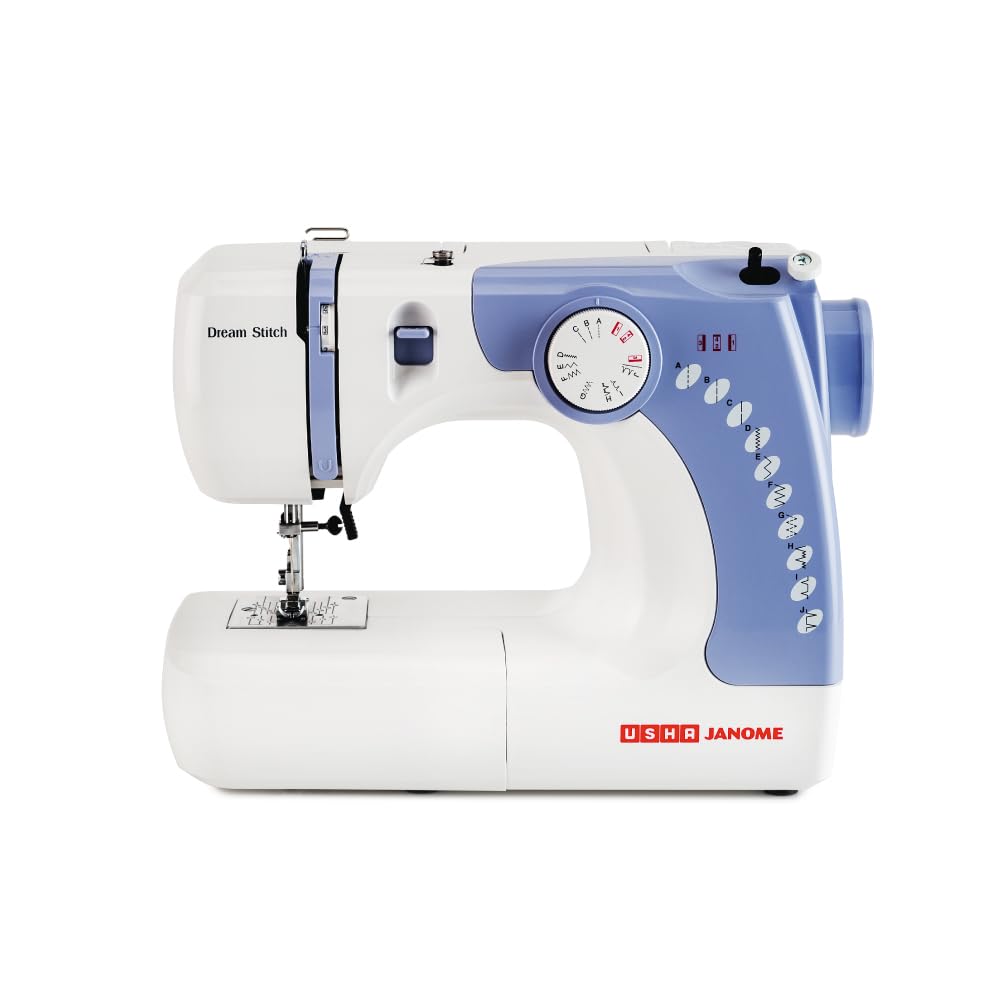
Buying a sewing machine for the home sounds simple until you actually start comparing models. One machine has more stitch patterns. Another looks more powerful. Some are designed for beginners, while others are aimed at people who already know how to sew. Then there is the question that matters most for many Indian households: will the machine actually make everyday stitching easier, or will it end up sitting unused in a corner?
The Usha Janome Dream Stitch Automatic Zig-Zag Electric Sewing Machine has been around for quite some time and continues to attract buyers looking for a practical machine for home sewing, alterations, repairs, and learning.
It isn’t marketed as an advanced computerized sewing machine. Instead, it takes a relatively straightforward approach, combining electric operation with automatic zig-zag stitching, several built-in stitch options, a compact free arm, and features intended to make common sewing jobs easier.
But does it still make sense to buy the Usha Janome Dream Stitch in 2026?
That’s what this review is about.
I’ve looked at the machine’s specifications, its intended use, available customer feedback, strengths, limitations, and the things you should know before ordering. The goal isn’t to tell you that it’s perfect. No sewing machine is.
Instead, this review will help you decide whether the Dream Stitch is the right fit for your particular sewing needs.
Usha Janome Dream Stitch: Quick Overview
The Usha Janome Dream Stitch is an automatic zig-zag electric sewing machine designed primarily for household sewing.
It has a compact design and offers 7 built-in stitches with 14 stitch functions. These include useful options for everyday sewing as well as applications such as buttonholing, lace fixing, quilting, smocking, and rolled hemming.
The machine has a dial-type stitch pattern selector and manual thread tension control. It also has stitch-length control and a triple-strength stitch option.
Its stated sewing speed is up to 550 stitches per minute, which is a reasonable level for a home machine where control and ease of use are generally more important than extremely high speed.
The machine also includes a compact free arm, which can be useful when working on smaller or tubular areas such as sleeves and cuffs.
So, on paper, it offers a useful mix of basic and decorative sewing capabilities without becoming unnecessarily complicated.
What Makes the Dream Stitch Popular?
There is a simple reason this machine continues to attract attention: it sits somewhere between an old-fashioned manual sewing machine and a much more advanced computerized model.
For someone who wants to stitch clothes, repair garments, alter trousers, make simple home décor items, or learn sewing, spending money on a highly advanced machine may not be necessary.
The Dream Stitch provides electric operation and multiple stitch choices while keeping the controls relatively straightforward.
That combination is particularly attractive for beginners.
A number of customer reviews and review aggregations describe the machine as easy to use, useful for basic stitching, and suitable for people learning to sew. Some users also mention using it for everyday household jobs rather than professional industrial work.
That distinction is important.
This is fundamentally a home sewing machine, not an industrial tailoring machine.
Design and Build
The Dream Stitch has a relatively compact design, making it easier to place on a household table when you want to sew and store afterward.
The compact free-arm design is one of its practical features. Free-arm sewing can be helpful when stitching areas that are difficult to handle on a conventional flat sewing bed.
The machine is also designed around a fairly conventional control layout.
Instead of navigating a digital display, users select stitch patterns using a dial. Thread tension is manually controlled as well.
Some people will see this as a positive because there are fewer electronic controls to learn.
Others may prefer a computerized machine where stitch selection and settings are more automated.
For a beginner, however, simple controls can actually be an advantage.
You can gradually learn what each setting does rather than depending entirely on automatic adjustments.
Stitch Options and Applications
One of the main selling points of the Usha Janome Dream Stitch is its variety of stitching functions.
The machine provides 7 built-in stitches and 14 stitch functions, including a 4-step buttonhole function. The listed applications include lace fixing, quilting, smocking, and rolled hemming.
For a home user, that is a useful range.
Most people aren’t going to use dozens of decorative stitches every week. What they actually need is a reliable straight stitch, zig-zag capability, buttonhole functionality, and a few additional options for different projects.
The Dream Stitch provides those basics while adding some room to experiment.
If you’re learning sewing, having multiple stitch types can also make the machine more interesting because you’re not restricted to straight stitching.
Is It Good for Beginners?
This is probably where the Dream Stitch makes the most sense.
A first sewing machine can be intimidating.
There are bobbins, needles, thread tension, stitch selection, presser feet, threading, and fabric handling to understand. If the machine itself is overly complicated, learning the actual craft becomes harder.
The Dream Stitch keeps many of the controls mechanical and straightforward.
Customer feedback frequently highlights its beginner-friendly nature. Some users have reported being able to learn the machine relatively quickly, while other feedback praises its usefulness for basic home sewing and alterations.
Of course, “easy to use” doesn’t mean you can take it out of the box and immediately sew perfectly.
There is still a learning curve.
You need to understand how to thread the machine correctly, wind and insert the bobbin, choose the appropriate stitch, adjust tension when necessary, and guide fabric properly.
But those are sewing skills rather than problems unique to the machine.
For someone willing to spend a little time learning, the Dream Stitch can be a sensible starting point.
Sewing Speed
The machine is listed with a sewing speed of 550 stitches per minute.
For household use, that is perfectly reasonable.
Speed isn’t necessarily the most important specification when you’re starting out.
In fact, a machine that is extremely fast can be harder for a beginner to control. When you’re learning to sew straight lines, turn corners, follow patterns, or work around curves, having enough control is often more valuable than maximum speed.
The Dream Stitch’s speed is therefore better viewed as suitable for everyday home sewing rather than professional high-volume production.
If you’re planning to operate a tailoring business where the machine will run continuously for hours every day, you may want to consider a machine specifically designed for that workload.
For normal home stitching, however, the speed should be adequate for many common projects.
What Can You Sew With It?
The answer depends partly on your experience and the fabric you’re using.
For ordinary household projects, the Dream Stitch can be useful for tasks such as:
- Altering clothing
- Repairing small tears
- Hemming trousers
- Stitching simple garments
- Working on children’s clothing
- Making basic home accessories
- Buttonholes
- Decorative stitching
- Lace-related work
- Simple quilting projects
- Sleeve and cuff work
The machine’s listed applications include quilting, smocking, lace fixing, and rolled hemming, which gives it more flexibility than a basic straight-stitch-only machine.
However, don’t confuse “multiple applications” with unlimited fabric capability.
Very thick layers of heavy fabric can be challenging for many domestic sewing machines.
If your primary goal is stitching heavy denim, multiple layers of upholstery fabric, canvas, or other demanding materials on a regular basis, you should look for a machine specifically designed for heavier-duty work.
Free Arm: A Small Feature That Can Be Useful
The compact free arm is one of those features that doesn’t sound particularly exciting until you actually need it.
When working on narrow or tubular sections of clothing, having the ability to sew around the free arm can make the job easier.
Sleeves and cuffs are common examples.
Instead of trying to manipulate the entire garment around a large flat sewing surface, the free-arm configuration gives you more access to smaller areas.
It’s not something every beginner will use immediately, but once you start making or altering clothes, you may appreciate it.
Buttonholes and Decorative Stitching
Buttonholes are another useful feature.
The Dream Stitch uses a 4-step buttonhole function.
For someone who only needs buttonholes occasionally, this can be enough.
It won’t provide the one-touch automation found on some computerized machines, but it gives you a dedicated process for creating buttonholes.
The decorative stitch functions also give beginners an opportunity to move beyond basic repairs.
If you’re interested in modifying clothes, adding decorative details, or experimenting with different patterns, these extra functions can make the machine more versatile.
Drop Feed for Embroidery
The Dream Stitch also includes a drop-feed feature intended for embroidery work.
This is another example of the machine offering more than basic straight and zig-zag stitching.
However, free-motion or machine embroidery requires practice.
The machine having a drop-feed function doesn’t mean someone with no embroidery experience will instantly produce professional designs.
Your results will depend on your fabric, thread, needle, hoop or technique, and especially your practice.
For someone who wants to learn, though, having the option available is useful.
What Customers Like About the Dream Stitch
Looking across available customer feedback, a few themes appear repeatedly.
Easy Learning Curve
Several reviews describe the machine as easy to use, particularly for beginners.
That’s important because complicated controls can discourage new users.
Good for Everyday Sewing
The machine is commonly described as useful for household stitching, alterations, repairs, and similar everyday tasks.
That’s really where its strengths lie.
Useful Stitch Selection
The combination of built-in stitches and multiple functions gives users enough variety without overwhelming them with a huge number of patterns.
Compact Design
The relatively compact format makes it practical for people who don’t have a permanent sewing room.
You can set it up when needed and store it afterward.
Established Brand
Usha is a familiar name in India’s sewing-machine market, and the Janome association is another factor that attracts buyers looking for a recognized machine rather than an unknown budget model.
What Customers Don’t Like
A balanced review also needs to discuss the negatives.
One issue that appears in available feedback is after-sales service and demonstration support.
Some user feedback praises the machine itself while criticizing the quality or availability of service or complaining that a product demonstration was not provided.
This is worth considering before purchasing.
A sewing machine can be excellent, but beginners sometimes need help with threading, bobbin setup, tension, or basic operation.
There are also isolated online complaints about service experiences. These should not automatically be treated as proof that every customer will have the same experience, but they are worth keeping in mind.
The safest approach is to check the warranty and support details available with the current listing and retain your purchase invoice.
Is It Suitable for Professional Tailoring?
This is where you need to be realistic.
The Dream Stitch can certainly be useful for someone who does sewing work from home, especially simple alterations and smaller projects.
But if you’re planning to operate a busy tailoring shop and need a machine capable of continuous heavy-duty use, you should compare it with purpose-built commercial or industrial models.
A domestic machine is designed around household convenience.
Professional tailoring can involve long hours, thicker fabrics, repetitive stitching, and much greater workload.
For occasional income-generating work, the Dream Stitch may be worth considering.
For a high-volume tailoring operation, I’d look at more specialized machines.
Is It Good for Alterations?
Yes, this is one of the areas where the machine makes a lot of sense.
Alterations don’t always require complicated equipment.
Hemming, repairing seams, adjusting garments, stitching smaller sections, and making basic modifications are common household jobs.
The Dream Stitch provides the stitch options and control needed for these types of tasks.
If you regularly pay someone else to make small clothing repairs, owning a machine can eventually become useful beyond the initial purchase.
Of course, the financial value depends on how often you actually sew.
If you only need one alteration every few months, buying any sewing machine may not make sense.
If you sew regularly, however, a machine can quickly become one of those household tools you wonder how you managed without.
What About Thick Fabric?
This is an area where buyers should keep their expectations under control.
The Dream Stitch is a household sewing machine. It isn’t marketed as an industrial heavy-duty machine.
Light and medium-weight fabrics are a more natural fit.
When working with thicker materials, the result can depend on the number of layers, needle type, thread, stitch selection, and how carefully the fabric is fed.
If your regular projects involve multiple layers of denim or very thick material, compare heavy-duty models before buying.
For ordinary clothing, repairs, cotton fabrics, and similar household work, the Dream Stitch is more appropriately positioned.
Warranty and Purchase Considerations
Before ordering, don’t look only at the price.
Check the current listing for the exact warranty information, seller details, delivery terms, included accessories, and return policy.
Current product listings describe a 2-year manufacturer’s warranty, with the Amazon invoice indicated as sufficient for warranty claims.
Still, terms can change, so verify the information shown at the time you place your order.
Also inspect the package when it arrives.
Make sure the machine and listed accessories are present, keep the invoice, and test the basic functions rather than leaving the machine unopened for weeks.
Usha Janome Dream Stitch Pros and Cons
Pros
- Beginner-friendly design
- Automatic zig-zag functionality
- 7 built-in stitches
- 14 stitch functions
- 4-step buttonhole function
- Free-arm sewing
- Drop-feed function
- Sewing light
- Manual stitch and tension controls
- Suitable for many everyday home sewing jobs
- Compact design
- Established brand
Cons
- Not intended to replace an industrial sewing machine
- Manual controls may feel less convenient than computerized machines
- Thick and multiple layers of heavy fabric can be challenging
- Some customer feedback raises concerns about demonstrations or after-sales service
- Beginners still need to learn basic threading and sewing techniques
Usha Janome Dream Stitch vs. Buying a Cheaper Machine
It’s tempting to choose the cheapest sewing machine you can find.
But price shouldn’t be your only consideration.
A very cheap machine might look attractive initially, but if it lacks useful stitch functions, accessories, service support, or replacement parts, the saving may not be worth it.
The Dream Stitch is positioned as a more established option for people who want a recognizable brand and a reasonable collection of functions.
That doesn’t mean it’s automatically better than every cheaper machine.
It simply means you should compare the complete package rather than looking at the number on the price tag.
Who Should Buy the Usha Janome Dream Stitch?
I’d consider the Dream Stitch particularly suitable for:
Beginners: If you’re learning sewing for the first time, the relatively straightforward controls are appealing.
Home users: If you mainly need a machine for clothing repairs, alterations, hemming, and household sewing, its feature set makes sense.
Hobbyists: If you want to experiment with different stitches, quilting, smocking, or other creative projects, the additional functions give you room to learn.
Occasional home tailoring: If you make clothes or perform small tailoring jobs at home, the machine can be useful.
Who Should Look Elsewhere?
You may want another machine if:
- You need industrial-level continuous operation
- You primarily work with extremely thick fabrics
- You want computerized stitch selection
- You need a very large number of decorative stitches
- You want advanced automatic features
- You expect professional-level production speed
In those cases, spending more on a machine designed specifically for your requirements may be the better long-term decision.
Final Verdict: Is Usha Janome Dream Stitch Worth Buying?
The Usha Janome Dream Stitch isn’t trying to be everything to everyone.
And that’s actually one of its strengths.
It is a practical domestic sewing machine with enough features to handle much more than basic straight stitching, while remaining approachable for someone who is learning.
The combination of 7 built-in stitches, 14 stitch functions, buttonhole capability, free-arm sewing, drop-feed functionality, sewing light, and a 550-stitches-per-minute stated speed gives it a useful range for household sewing.
Customer feedback also points toward ease of use and usefulness for basic home sewing, although service and demonstration experiences are not universally positive.
So, is it worth buying?
For a beginner or home user who wants a reliable, reasonably versatile electric sewing machine, the Usha Janome Dream Stitch is a strong option to consider.
It’s especially suitable if your priorities are clothing alterations, repairs, basic garment making, and learning sewing.
Just don’t buy it expecting an industrial machine.
And don’t choose it solely because of the Usha name. Think about what you actually intend to sew.
If your projects match what the machine is designed for, its combination of simplicity, stitch variety, and household functionality makes a lot of sense.
Frequently Asked Questions
Is Usha Janome Dream Stitch good for beginners?
Yes. Its relatively straightforward controls and useful range of stitch functions make it suitable for people learning sewing. Customer feedback also frequently highlights ease of use for beginners.
How many stitches does the Usha Janome Dream Stitch have?
The machine is listed with 7 built-in stitches and 14 stitch functions. It also includes a 4-step buttonhole function.
What is the sewing speed of the Dream Stitch?
The listed sewing speed is 550 stitches per minute.
Can the Dream Stitch sew denim?
It can handle many ordinary household sewing tasks, but it shouldn’t be confused with a heavy-duty or industrial machine. Multiple thick layers of denim may be challenging, so users working primarily with heavy fabrics should consider a dedicated heavy-duty model.
Does the machine have a free arm?
Yes. The Dream Stitch has a compact free-arm design, which can be useful for sewing areas such as sleeves and cuffs.
Does it have a buttonhole function?
Yes. The machine includes a 4-step buttonhole function.
Is the Dream Stitch automatic?
It is an automatic zig-zag electric sewing machine, but it still uses manual controls for areas such as thread tension and stitch selection.
Does it have a sewing light?
Yes, the listed specifications include a sewing light.
Does it come with a warranty?
Current listings indicate a 2-year manufacturer’s warranty, but buyers should verify the exact warranty terms on the Amazon listing when ordering because product terms can change.
Where should I buy the Usha Janome Dream Stitch?
For the exact model reviewed here, you can check the current Amazon listing, where you can see the latest price, seller information, delivery details, and current purchase terms.
Bottom Line
The best sewing machine isn’t necessarily the one with the most features.
It’s the one you’ll actually enjoy using.
For a beginner who wants to learn sewing, a parent who wants to handle household alterations, a hobbyist working on small creative projects, or someone who simply wants an electric machine for regular home stitching, the Usha Janome Dream Stitch offers a sensible balance of functionality and simplicity.
It has enough stitch variety to keep things interesting without turning the learning process into a technical exercise.
Just remember to keep expectations realistic. It is a domestic sewing machine, not an industrial workhorse, and customer experiences with service and demonstrations can vary.
If your needs are primarily household sewing and alterations, however, this is a model worth putting on your shortlist.
Affiliate Disclosure: This article may contain affiliate links. If you purchase through a qualifying link, the website may earn a commission at no additional cost to you.
Disclaimer: Product specifications, pricing, availability, warranty terms, accessories, and seller information can change. Always verify the current Amazon listing before purchasing. Customer experiences vary, and no single review should be treated as a guarantee of future performance.

